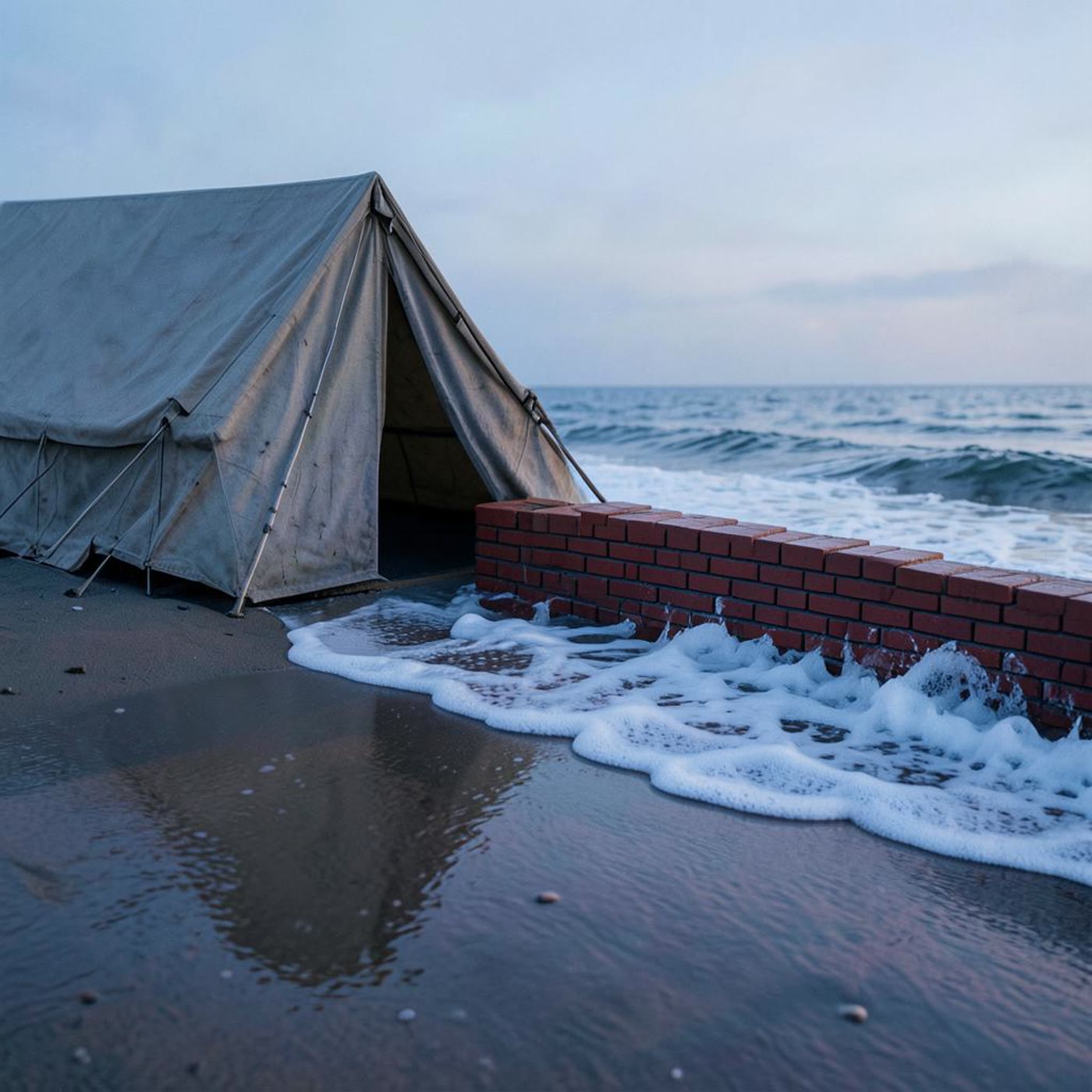
The sea pulls back and shows you all this land. Build on it — and keep one eye on the water.
Deep therapeutic work — art therapy in the form of music.
What “All This Land” is about
All This Land is a song about a new frontier that might be a warning. Before a tsunami, the sea pulls back from the beach and leaves a wide stretch of new sand — and the first thought is: look at all this land. Set up a tent. Build a home. NEO wrote it from a picture his friend David gave him in a Do-Re-Mi conversation, about how this moment in technology feels: work that was impossible yesterday is possible today, and nobody fully knows what comes next. The song starts in wonder, with one fragile voice and one repeating figure, then the walls go up, brick by brick, and doubt creeps in until the wave comes back, tall as the sky. It ends half-laughing at the water: enjoy it before it destroys us. It is NEO's own work, produced by Mi. Listen free on Mi.
About “All This Land”
Before a tsunami, the ocean backs away from the beach and leaves a wide stretch of new sand. The first thought is not fear. It is “look at all this land.” NEO wrote All This Land from that picture — a friend's, David's, from a Do-Re-Mi conversation — about the new frontier everyone feels right now: so much is suddenly possible, and nobody knows what is coming back. The song is built like the tide. It opens hushed, one voice and one repeating figure, full of wonder — room for us, a tent for us, a home for us. Then the heavy wall comes in, brick by brick, the sea starts asking questions, and the wave rises until it fills the sky. It is the first song made in Mi.'s Studio Sol, start to finish in a day, and it lands on Why Mi? because it asks the same question the album does: what are we building, and will the ground hold?
The journey
- 01
The Sea Pulls Back
Wonder. The water leaves, the sand appears — room for us, a tent for us, a home for us.
- 02
All This Land
Room for all the life we meant to live.
- 03
Big Plans
The laugh stops for a second. Who knows what comes next?
- 04
Brick by Brick
Heart and years poured into a patch of sand. The walls go up, and the sea starts asking questions.
- 05
The Wave
Hush — what's that sound? The wave comes back, tall as the sky. Was this ours at all?
- 06
Enjoy It
Watching the water, still half-laughing: enjoy it before it destroys us.
In their words
“The sea pulls back. Look at all this sand.” — NEO
“I guess we should all enjoy it before it destroys us.” — David
Lyrics
Room Room for us The sea pulls back. Look at all this sand. Tent Tent for us I plant our tent where the waves once was. Come Come to me Come and see, take my hand. Home A home for us I'll build a home. For us. Just look At all of this land There's room for all the life we meant to live. Yes, all this land Who knows what comes next? I've got big plans. Patch Patch of land I pour my heart and years into this patch of sand. Brick Brick by brick I build these walls and call them ours. Drag A slow drag "I feel a drag; what's next?" the sea asks me. Could all this slip out of my hand? Hush What's that sound? The wave comes back, tall as the sky. All this land, slipping Is this real? Will this ground hold? All this land Was this ours at all? Watch the sea. I guess, enjoy it before it destroys us. We'll see.
Lyrics © Mi. / the Re. Read the lyric sheet in the app.
“Enjoy It Before It Destroys Us” — A Musician on AI Music, Theft and Healing
The conversation this song came from. NEO plays his songs for David, a working musician of 30 years, and David answers with the picture of a tsunami: the sea backs away, and everyone builds on the new beach.
The full story of this video›
All This Land began as one image in a long, honest conversation between two old friends. David has played music for more than 30 years and taught NEO guitar. When NEO built Mi., a place where people turn their own pain into songs with the help of AI, David was the listener whose verdict mattered most — because David also believes much of AI music rests on work taken from human artists without asking.
The episode moves through NEO's songs one at a time: the first rough track that showed what was possible, the song that made his support group ask how he did it, a werewolf story that holds a secret he swore he would never tell, and a storm song that never ends on purpose. Between them, the two argue about grit, training data, musicians who can no longer earn a living, and whether a song made this way can still heal the person it is about.
Near the end, David reaches for an analogy. Before a tsunami, the ocean pulls back and uncovers a wide new beach, and people walk out and start to build. That is how this moment in technology feels to him: more is possible every day, and nobody knows what is coming back. "I guess we should all enjoy it before it destroys us." NEO took that picture home and made All This Land from it — the wonder first, then the walls, then the water.

The story behind the song
All This Land: When the Sea Pulls Back Before the Wave
Room for us. A tent for us. A home for us. Then: what's that sound?
Before a tsunami, the ocean backs away from the beach. A wide stretch of new sand appears where the water was. The first thought is not fear. It is: look at all this land.
That picture came from David, in a Do-Re-Mi conversation with NEO. He was talking about this moment in technology: work that was impossible yesterday is possible today, and it feels like a new frontier. Set up a tent. Build some beachfront property. But who knows what is coming back?
“I guess we should all enjoy it before it destroys us.”
— David
Built like the tide
The song opens hushed: one fragile voice and one repeating figure, full of wonder. Room for us. A tent for us. A home for us. The key keeps climbing under the same figure, so the ground seems to rise under you.
Then the heavy wall comes in, brick by brick. The sea starts asking questions. The wave comes back, tall as the sky, and the last question is the one the whole song was building toward: was this ours at all?
Made in a day
All This Land is the first song made in Mi.'s Studio Sol, from NEO's first brain dump to a released track in one day. Sixteen takes went up for the community vote. The one that stayed, Room for Us, was finished by hand in the studio: the first line re-sung, a glitch added to the crescendo.
It sits on Why Mi?, the album that journals building Mi. itself, because it asks the same question the album does: what are we building, and will the ground hold? Listen free on Mi.
About Noel (NEO)
Codename: NEO is the architect of the 'Mi. iM Heard' frequency protocol—a relentless creator who transforms raw trauma into undeniable power. Defying the gravity of default programming, NEO operates at the intersection of brutal authenticity and sonic art therapy. He builds anthems for the black sheep, the eagles, and the rare few willing to lock shields and hold the line. His work doesn't just entertain; it physically alchemizes pain into a cure. When the world demands conformity, NEO delivers defiance, crafting the soundtrack for those ready to unplug from the matrix and discover their true voice.
More from Noel (NEO)
All This Land is the second entry on Why Mi?, after Schrödinger's Masterpiece. The episode with David, where this picture comes from, is below.
The Making Of
The Inspiration
Symphonic space rock in a lilting triple pulse — one synth-and-strings arpeggio repeats while the key keeps climbing, carrying a lone fragile tenor from a hushed hall into a heavy fuzz-guitar wall.
- Symphonic space rock
- Lilting 3/4 triple pulse
- Fragile ornamented tenor
- Half-laughing falsetto cries
- One arpeggio, climbing keys
- Live drums held back to the last stage
- Synth-and-strings arpeggio
- Fuzz-bass foundation · 2
- Hushed-to-explosive dynamics · 2
- Glitch crescendo
- Uneasy wonder
- Slow-burn dread · 2
This track was generated with AI from a documented analysis of a genre's structural elements — tempo, vocal delivery, arrangement, and production aesthetic. Mi. publishes that analysis below. Any resemblance to a specific recording artist's voice or composition is a coincidence of methodology, not imitation.
Sonic Architecture
Vocal Delivery
One male tenor carries the whole story. In the first stage he is close and fragile, nearly a whisper, holding and ornamenting the word “us” at the end of each line. As the song grows he climbs, and the short one-syllable phrases turn into wry, half-laughing high cries — wonder first, then doubt, then dread, and in the outro a tired laugh while he watches the water.
Structure
No pop verse-and-chorus engine. The song moves in three stages over one repeating arpeggio: a hushed classical opening under the lone voice, a short pulsing electronic middle, and a heavy final stage. The key steps up again and again around that same figure, so the ground feels like it is rising under you. It ends on one huge crash and a cut to silence.
Production Aesthetic
A synth-and-strings arpeggio in a lilting three, with live drums held back until the last stage. When they arrive, fuzz guitar, distorted low fuzz bass and a thundering kit build a full wall, with tom rolls into each key change. A glitched, stuttering crescendo near the top was added by hand in the studio. Quiet opening, loud compressed finish.
Mood Territory
Uneasy wonder. The song is excited about the new land and never quite believes it. The laugh in the voice is real, and so is the wave.
How this song was made
All This Land came out of deep therapeutic work — art therapy in the form of music — with Noel (NEO)'s own words shaped into a song and produced by Mi. The words above are Noel (NEO)'s own; the lyrics are Mi.'s and the Re's. How Mi. works · Listen and read the lyrics in the app.
Mi. — iM HEARD · songs made from real conversations, each one written for the person who lived it.