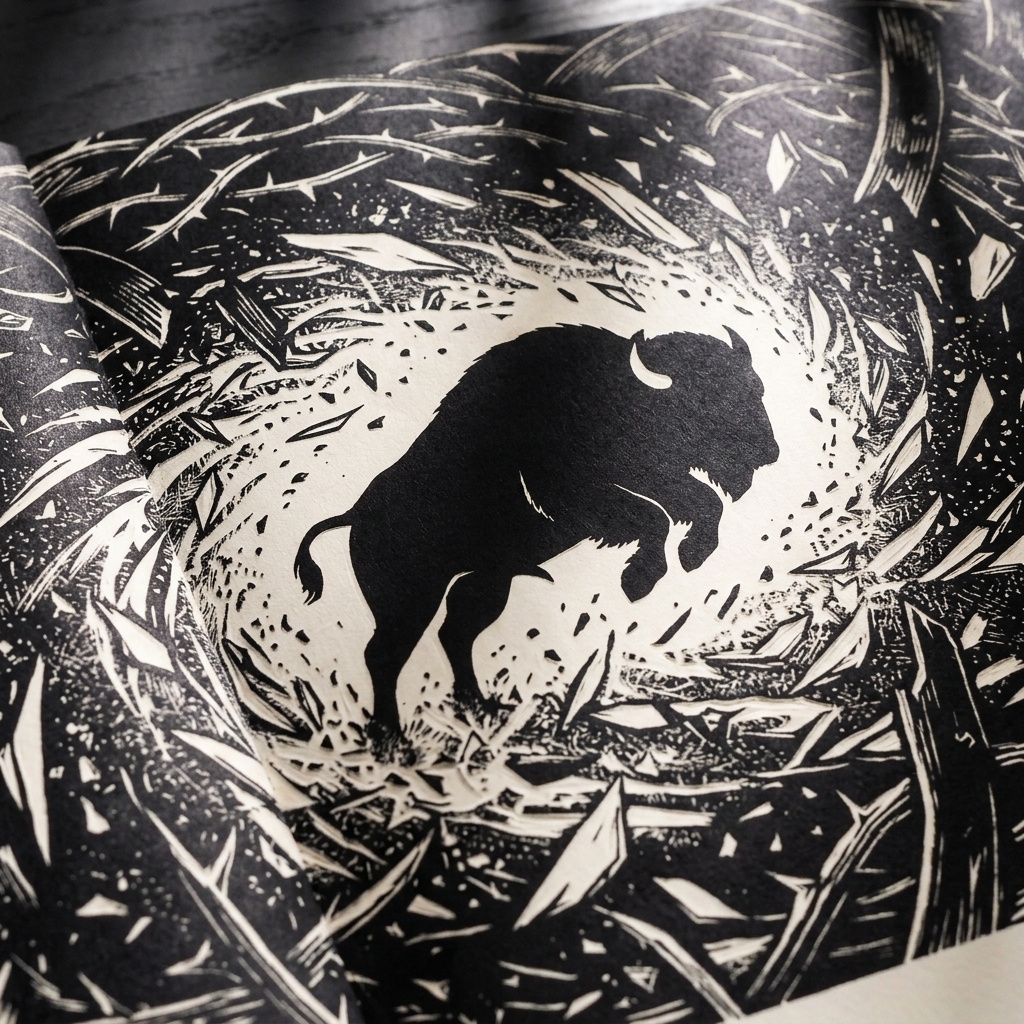
Face the storm like the bison — lean in, take every hit… and learn what happens when the wind just is.
Deep therapeutic work — art therapy in the form of music.
A Book of Plates — A printed book on a desk under slatted light. Every spread is a plate — the bison charging a storm that always shows a far edge — and the pages turn while the doctrine still holds. Then a page where the storm is gone, and there is nothing left to charge.
The full story of this video›
The video tells Bison the way the song was lived: as a story someone else printed and handed you. A book lies open on a desk under slatted light, and every spread is a plate from the same doctrine — the bison lowering its head and charging into the storm, because the storm always shows a far edge, and charging is what bison are for. The pages keep turning. The plates keep agreeing with each other. That is what a belief system looks like from the inside.
The animation leans into the lo-fi grain of the track — abraded, saturated, run through tape — and it earns its strangest choices. A raven's whistle the animation surfaced by accident sits against the guitar solo like it was scored. The karaoke lyric is deliberately hard to read, because this is a hard story to tell. And the ending refuses the triumphant final charge: an eye becomes a planet becomes a black hole, and the picture holds on black for nearly a full minute before the last page turns — to a plate where the storm is simply gone, and there is nothing left to charge at.
It is a music video about burnout that never says the word: what it costs to keep charging weather because a book told you that's what you are.
What “Bison” is about
Bison is a song about facing pain head-on — and about what happens when the pain doesn't end. It starts from the old plains wisdom: cattle run from a storm and stay in it longer; the bison charges through and comes out the other side. The verses are the discipline of that charge — clocking in, strengthening the muscle of grief, calling the pain a finish line. Then the bridge breaks the metaphor: you can walk through a hurricane, because a hurricane ends — but you can't walk through the wind when the wind just is. In NEO's words: “I thought the pain was a finish line.” The final chorus charges anyway; the courage was real even when the doctrine was wrong. Bison came out of NEO's deep therapeutic work — art therapy in the form of music — produced by Mi.; it opens the album Esc. Listen with karaoke lyrics, free, on Mi.
About “Bison”
Built on the old plains wisdom: cattle run from the storm and stay in it longer; the bison charges through and comes out the other side. The verses are the discipline of the charge — clocking in, bringing the talking stick and the clock and the keys to his own padlock, strengthening the muscle of grief and calling the pain a finish line. The choruses are the charge itself, shouted raw. And then the bridge breaks the metaphor's neck: the sunlight never came, because you can walk through a hurricane — a hurricane ends — but you can't walk through the wind when the wind just is. The final chorus charges anyway. That's the song: the courage was real even when the doctrine was wrong.
The journey
- 01
The Grind
Clocking in, leash on the mind — carrying the keys to his own padlock.
- 02
The Herd
The plains wisdom: the herd runs and gets chased down; look it in the eye instead.
- 03
Playing the Bison
The charge — lean into the wind, take every hit, certain there's a far side.
- 04
The Slaughterhouse Line
Reset the date, swallow the key — begging the butcher for a sign.
- 05
The Wind Just Is
The reveal that breaks the doctrine: a hurricane ends. The wind doesn't.
In NEO's words
“You can walk through a hurricane... because a hurricane ends.” — NEO
“I thought the pain was a finish line.” — NEO
Lyrics
Clocking in on the hourly grind Tying a leash to the back of my mind Strapped to the chair for the polygraph wire Walking myself back into the fire I brought the talking stick, I brought the clock I brought the keys to my own padlock I thought the shame was a friend of mine... I thought the pain was a finish line. They say the herd will turn and run And get chased down by the setting sun. But if you look it in the eye... You'll break into an open sky. So I played the Bison! I leaned into the wind! I let the hurricane tear off my skin! I stood in the center, I took every hit Thinking I'd finally walk out of it! But there was no clearing... there was no end... there was no end... Reset the date, reset the clock Swallow the key, rattle the lock A simple hug, a simple pledge Balancing on a razor's edge I tried to strengthen the muscle of grief I tried to buy a single second of relief I was a cow in a slaughterhouse line... Begging the butcher to give me a sign. The herd will turn and run And get chased down by the setting sun. But if you charge the hurricane... You buy your freedom with the pain. So I played the Bison! I leaned into the wind! I let the hurricane tear off my skin! I stood in the center, I took every hit Thinking I'd finally walk out of it! But there was no clear end insight... there was no end... There was no end... The sunlight never came. I just got comfortable sitting in the shame. You can walk through a hurricane... Because a hurricane ends. But you can't walk through the wind... When the wind just is. So I played the Bison! I leaned into the wind! I let the hurricane tear off my skin! I stood in the center, I took every hit Thinking I'd finally walk out of it! But there was no clearing... there was no end... I played the Bison. yeah Waiting for the sun. The storm was just you. Look what I've done.
Lyrics © Mi. / the Re. Karaoke-synced in the app.
Behind the Music
The story behind “Bison” — the session, the writing, and what it took to get it out. Watch on Mi.’s YouTube channel.
The full story of this video›
Eighty-two minutes, no script, no second take. Noel sits down with Rick — the coach whose work pulled him out of the storm and inspired this song — on the day Rick has finally named the pattern he'd been hunting through thousands of years of writing: why the things we build to save ourselves end up owning us.
Rick's frame is simple and merciless. The desire is never the problem — the money, the strength, the safety, the belonging are all good. The problem is the bypass: wanting the result without becoming the person who can carry it. Every strategy gets the same appraisal — greed, pride, fear, victimhood, even self-punishment wearing faith as a costume — and every counterfeit has the same tell: the more it works, the less it works, until the thing that promised safety is the thing you can't afford to lose. Midway through, the theory stops being theory: Noel brings a live dilemma, and Rick walks it from pride to fear to the root in about four minutes, on camera.
Then, an hour in, Noel plays him Bison — the song this session's work made possible — and Rick hands back the verdict the whole story was waiting for: the desire was good, but it was placed in a counterfeit promise. They called you to be the bison while they were the storm. And bison, it turns out, were never built to charge weather. The episode closes with the announcement that started everything since: Rick's work and Mi.'s music are now one collaboration.
This Is Probably the Greatest Song I've Created. — Noel on why Bison is the one — the song, the session, and what it took to get it out. On Mi.'s YouTube channel.
The full story of this video›
This is the process chapter: the Bison music video, screened live for the friends who watched it get made — followed by the whole machine, hood open. Not a tool demo. The actual pipeline that turns a finished song into a documentary-grade animated film inside a working day: lyric sync first, then a scene map that carries every in and out point, then stills, then motion, then an edit that mostly assembles itself because the map already did the deciding.
The honest arithmetic is the heart of it. A video like this is supposed to take sixty-plus hours or a real budget; this one took about twelve — two on the lyric map, six on stills, six on motion, two in the edit. The method is a painter's: block in the big shapes across the entire song before polishing anything, so you never spend twenty hours rendering one eye for a composition that doesn't exist yet. The screening also owns its accidents — the raven whistle that landed on the guitar solo, the karaoke lyric kept deliberately hard to read, the ending that collapses into a minute of black and stays there.
Underneath the workflow is the reason for it: a catalog of two hundred songs from real therapeutic work, each one platformed with a video and a story like this one — because being heard at that scale only happens if the process itself is the instrument.
About Noel (NEO)
Codename: NEO is the architect of the 'Mi. iM Heard' frequency protocol—a relentless creator who transforms raw trauma into undeniable power. Defying the gravity of default programming, NEO operates at the intersection of brutal authenticity and sonic art therapy. He builds anthems for the black sheep, the eagles, and the rare few willing to lock shields and hold the line. His work doesn't just entertain; it physically alchemizes pain into a cure. When the world demands conformity, NEO delivers defiance, crafting the soundtrack for those ready to unplug from the matrix and discover their true voice.
More from Noel (NEO)
Bison joins Overture and Roulette on Esc. — the album is filling in.
The Making Of
The Inspiration
Lo-fi garage punk with an alt-rock backbone — fuzz-bass and tape saturation under an exhausted gravelly baritone that breaks into raw, shouted choruses.
- Lo-fi
- Garage punk
- Alt rock
- 116 BPM plod
- Major-key grit
- Exhausted gravelly baritone
- Fuzz-treated vocal
- Raw shouted choruses — no harmonies
- Whispered tape-hiss bridge
- Verse–climb–fuzz-bath chorus
- Hard-stop vocal cuts
- Broken-machine guitar solo
- Fuzz-bass foundation
- Lo-fi tape saturation
- Dirty room-sound drums
- Weary defiance · 2
- Storm-facing
This track was generated with AI from a documented analysis of a genre's structural elements — tempo, vocal delivery, arrangement, and production aesthetic. Mi. publishes that analysis below. Any resemblance to a specific recording artist's voice or composition is a coincidence of methodology, not imitation.
Sonic Architecture
Vocal Delivery
An exhausted, gravelly baritone sung close to the mic with fuzz on the voice itself — conversational and heavy in the verses, tightening and going ragged through the pre-chorus climbs, then breaking into raw shouted choruses pushed through tape distortion, deliberately without harmonies or metal polish. The bridge drops to a whisper with audible tape hiss, and the final chorus is a distorted howl — unhinged, but still through the fuzz pedal, never a clean scream.
Structure
A slow, plodding verse-to-climb-to-fuzz-bath cycle at 116 BPM, run twice, with the vocals cutting off ABRUPTLY after each chorus into heavy instrumental grooves. After the whispered bridge the song hard-stops to total silence, drops a single fuzz-bass hit, and tears into a chaotic guitar solo before the final, most unhinged chorus. The last line lands quiet and spent.
Production Aesthetic
Fuzz-bass is the foundation of everything; dirty drums recorded with room sound; lo-fi tape saturation over the whole picture. The choruses are walls of dirty distortion — a fuzz-bath rather than a polished wall of sound — and the solo is fuzz-drenched wailing that sounds like a broken machine in a storm, garage feedback and all.
Mood Territory
Weary defiance. The song walks INTO the storm on purpose — the bison doctrine — and the production carries the cost of that: everything is abraded, saturated, run through tape. The reveal in the bridge lands as exhaustion rather than despair, and the final charge is triumphant in effort even as the lyric admits the wind doesn't end.
How this song was made
Bison came out of deep therapeutic work — art therapy in the form of music — with Noel (NEO)'s own words shaped into a song and produced by Mi. The words above are Noel (NEO)'s own; the lyrics are Mi.'s and the Re's. How Mi. works · Listen with karaoke lyrics in the app.
Mi. — iM HEARD · songs made from real conversations, each one written for the person who lived it.