
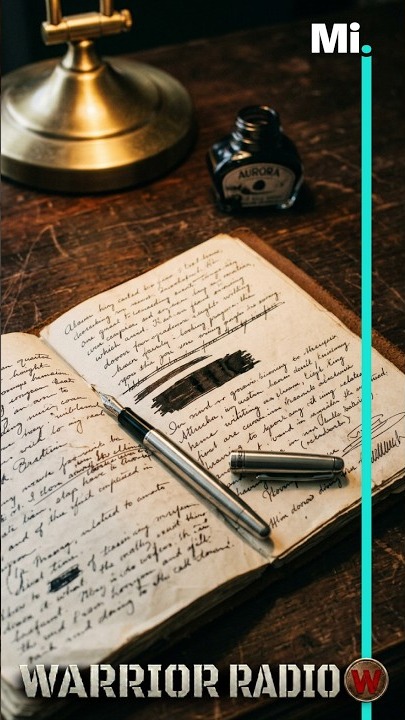
Write the name they called you in black ink. Interrogate it. Trace who said it. Strike it out.
Warrior's Way Mindset — a mentor's songs for men doing the work.
What “Blind Appraisals” is about
Blind Appraisals is the journaling move set to a swing. Somebody called you a loser once, and you've been defending against it ever since — so put it on the page and cross-examine it like a detective. Is the judgment true? Looks like it's not. So who said it? Someone who can't do a proper appraisal — someone who doesn't even know the workings of their own mind. Blind people can't give appraisals. A hard black line goes through the word, a silent pop, and the chains break: that stuff isn't mine. Turns out being me is just being me. From Rick's live demo of the appraisal test on a phalanx call — audited, not affirmed. If negative self-talk runs your nights — if you've ever typed 'am I a loser' into a search bar — this is the journaling move that answers the question with evidence instead of a pep talk. Listen free on Mi.
About “Blind Appraisals”
From a phalanx call, August 2026. Rick demonstrated the appraisal test in real time — 'They said I'm a loser. Am I a loser? Let's look at the loser stuff.' — and the song walks the same page: the ledger of every name they ever called you, the pen's interrogation in the forensic light, the trace back to judges who were blind all along, and the strike-through. The freedom at the end isn't a pep talk; it's a verdict you checked yourself.
The journey
- 01
The Ledger
Black ink on a bone-white page — every ghost up on the stage, every name they ever called you, walled inside a line.
- 02
Interrogation
'Am I a loser?' — the pen cross-examines the judgment in the forensic light. It looks like it's not true.
- 03
Strike It
Trace who said it: judges who can't do a proper appraisal, blind to their own minds. The chains worsen — then break.
- 04
The Verdict
A hard black line through the word. A silent pop. Blind people can't give appraisals.
- 05
Free
That stuff isn't mine. Turns out being me is just being me. I'm free.
In Rick's words
“They said I'm a loser. Am I a loser? Let's look at the loser stuff.” — Rick, running the move live
“Blind people can't give appraisals.” — Rick
“Turns out being me is just being me. I'm free.” — from the song
Lyrics
Black ink on a bone-white page Putting every ghost up on the stage Every single name they ever called Here inside this line, I have them walled There it is, in quiet black "He's a loser," no turning back "Am I a loser?" ask the pen Challenge the question, ask again I win a lot, I have my skills I can move the quiet hills Is that judgment true? The question lands Holding my whole life here in my hands It looks like it's not true, I have to write No, it's not true, in the forensic light It's an opinion, from a certain view From someone who can't do a proper appraisal, it's true So who are they? Let's trace the sound The ones who tried to run my soul to ground It looks like these people are all blind Don't even know the workings of their mind Their appraisal is from a blind person And with that thought, the chains all worsen, then they break A hard black line goes through the word A silent pop, the first I've heard Blind people can't give appraisals Their judgments are just hollow fables The judgments of people who can't see shit Is not a part of my identity The name that I was trying to defend Was from a judge who's blind, my friend They're fucking blind That stuff isn't mine I'm walking out across the line That stuff isn't mine Thank you, Lord, the sun can shine Turns out being me is not a loser Turns out being me is not a loser I'm free from this shit, I'm finally free Turns out being me is just being me I'm free
Lyrics © Mi. / the Re. Read the lyric sheet in the app.
Behind the Music
The story behind “Blind Appraisals” — the session, the writing, and what it took to get it out. Watch on Mi.’s YouTube channel.
The full story of this video›
This episode is a live demonstration disguised as a coaching call. Rick's opening claim: when you're locked in on journaling, growth starts happening around you. Then, instead of explaining the method, he runs it — out loud, in real time — on the harshest label in the room: 'They said I'm a loser. Am I a loser? Let's look at the loser stuff.'
The move is the appraisal test, and it works like a cross-examination. Write the name they called you in black ink. Ask whether the judgment is actually true — not whether it hurts, whether it's TRUE — and check it against the evidence of your real life. Then trace who said it, and notice what the song notices: the judges were blind. They couldn't do a proper appraisal of you because they'd never done one of themselves. The unlock arrives in one sentence: you don't have to change yourself for the opinions of people who don't know themselves.
Then the song plays the same page back — the ledger, the interrogation, the strike-through, the silent pop of a chain breaking — and lands somewhere no pep talk can take you, because you didn't believe your way there. You audited your way there. That stuff isn't yours. Being you is just being you.
The story behind the song
"Am I a Loser?" — The Journaling Move That Puts Your Worst Label on Trial
Somewhere, years ago, somebody called you something — and you've been defending against the word ever since. This is the song about getting it off you: not by affirmations, by auditing.
Somewhere, years ago, somebody called you something. Loser. Lazy. Too much. Not enough. You'd struggle to remember the day it happened — but you've been defending against the word ever since. It runs quietly in the background of decisions you think you're making freely.
This is the story of a song about getting that word off you. Not by affirmations, not by ignoring it — by auditing it. And the reason the song can teach the move is that it was born watching a real coach run it, live, on the worst label in the room.
The live demo
On a Warriors Way phalanx call, Rick (Codename: Curse Breaker) was talking about journaling — his claim being that when you're locked in on the page, growth starts happening around you. Then, instead of explaining, he demonstrated. Out loud. On himself:
“They said I'm a loser. Am I a loser? Let's look at the loser stuff.”
— Rick, live on the call
That sentence is doing something most self-help never dares: it takes the insult seriously. It doesn't flinch, doesn't reframe, doesn't rush to the mirror-pep-talk. It opens a case file.
The appraisal test — five steps
The move works like a cross-examination, and the song walks it stanza by stanza.
| Step | What you do | The song's line |
|---|---|---|
| 1 · The Ledger | Write the name they called you in black ink — all of them. | "Every ghost up on the stage… here inside this line, I have them walled" |
| 2 · Interrogation | Ask the only question that matters — not does it hurt, but is it TRUE, against the evidence of your real life. | "It looks like it's not true, I have to write" |
| 3 · Strike It | Trace who said it. Could they even see you? | "Their appraisal is from a blind person" |
| 4 · The Verdict | A hard black line through the word. | "A silent pop, the first I've heard" |
| 5 · Free | The label was extra weight. Identity was fine underneath. | "Turns out being me is just being me" |
The discovery that names the song arrives at step three: the judges were blind. A person who has never done an honest appraisal of themselves is not qualified to appraise you — the way you wouldn't accept a home appraisal from someone who's never seen a house. Rick's unlock, nearly verbatim: you don't have to change yourself for the opinions of people who don't know themselves.
Why it's a swing
Here's the production joke that makes the track: the darkest question a person can type into a search bar at 2 a.m. — am I a loser — gets answered as an up-tempo big-band swing, crooner-warm, brass stabs and all. Because the appraisal test isn't grief work. It's a courtroom victory, and the band knows the verdict before the singer finishes reading it. The strike-through lands on the downbeat. The freedom section is a victory lap.
Affirmations ask you to believe something. The appraisal test asks you to check something — and confidence you audited holds in weather that borrowed confidence can't survive.
Run it tonight
One page. One name they called you. Three questions: Is it true — against the evidence? Who said it? Could they see? Then the line through the word. That's the whole move. The song is three minutes long so you can keep it in your pocket for the days the label gets loud again.
Proud Sponsor
The Warrior's Way Mindset
This isn't just a men's group — it's a badass MENtor Group.
A mentorship community for men committed to personal development. Mindset coaching, the Battlefield of the Mind podcast, and a Discord brotherhood led by Rick.
Book a call →Sponsored content · Mi. partner
Upcoming Events
📅 Sat, Oct 17 · 10:00 AM CT
Q&A With Rick
Meet Rick, ask questions, find your place in the pack.
↻ Every Saturday · 📍 Virtual — the link drops in the Discord
Events in series
📅 Sat, Oct 17 · 10:00 AM CT
📅 Sat, Oct 24 · 10:00 AM CT
📅 Sat, Oct 31 · 10:00 AM CT
📅 Sat, Nov 7 · 10:00 AM CT
About Rick (Curse Breaker)
Rick: Codename: Curse Breaker breaks generational curses out loud. His teaching behind this one: journaling as forensics. When you're locked in on the page, growth starts happening around you — and the appraisal test is the sharpest tool in the notebook: don't ignore the label, audit it. He ran the whole move live, and the song keeps his verdict nearly verbatim.
More from Rick (Curse Breaker)
Blind Appraisals joins eight live tracks on What You Feed — the album born from the phalanx calls.
The Making Of
The Inspiration
A modern big-band swing in the classic crooner tradition — a warm male baritone over up-tempo brass and rhythm section, opening rubato and a cappella before the band kicks in, sung close and intimate against a big room.
- Big-band jazz-pop
- Modern crooner tradition
- Vocal-jazz lineage
- Up-tempo swing feel, ~140 BPM
- Free-tempo rubato a cappella intro
- Minor-key swing
- Male baritone crooner lead
- Intimate close-mic delivery
- Full big-band arrangement
- Swagger over a dark subject
- The verdict as a victory lap
This track was generated with AI from a documented analysis of a genre's structural elements — tempo, vocal delivery, arrangement, and production aesthetic. Mi. publishes that analysis below. Any resemblance to a specific recording artist's voice or composition is a coincidence of methodology, not imitation.
Sonic Architecture
Vocal Delivery
A warm male baritone in the crooner tradition — close-mic'd and conversational even at swing tempo, selling the darkest lines with a raised eyebrow rather than a raised voice. The intro arrives free-tempo and a cappella, the singer alone with the page before the band agrees with him.
Structure
The interrogation shapes the form: a rubato opening for the ledger, the band entering as the cross-examination gains confidence, and the swing hitting full stride exactly when the verdict lands — the strike-through as a downbeat. The freedom section rides out as a victory lap.
Production Aesthetic
A full big-band swing chart — brass stabs, walking bass, ride-driven drums — played up-tempo with an intimate vocal kept forward and close against the big room. The contrast is the charm: courtroom-dark subject matter delivered with dance-floor swagger.
Mood Territory
Swagger as medicine. The song takes the heaviest question a person can type into a search bar at 2 a.m. and answers it with a grin, a pen, and a horn section — because the verdict was never in doubt once the evidence got read.
How this song was made
Blind Appraisals came out of Rick's coaching and his own surrender — the Warrior's Way Mindset — with Rick's words shaped into a song and produced by Mi. The words above are Rick (Curse Breaker)'s own; the lyrics are Mi.'s and the Re's. How Mi. works · Listen and read the lyrics in the app.
Mi. — iM HEARD · songs made from real conversations, each one written for the person who lived it.